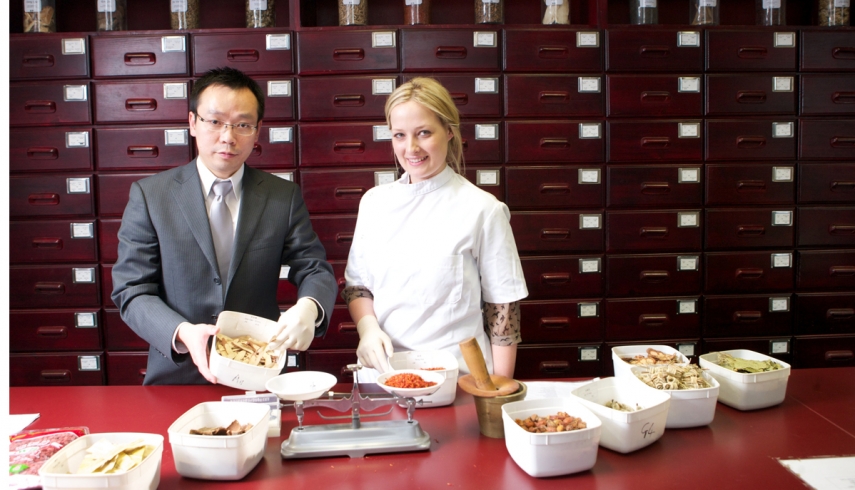
Sue Hewitt explores the exotic sights and smells of RMIT’s Chinese Medicine clinic in Bundoora, where ancient traditions meet western science.
The spicy aroma tickles the nostrils. A bouquet of heady floral, fungi and cinnamon scents, touched with a pinch of citrus, wafts in the air. It’s like taking in the perfume of a fine wine but, in fact, you are smelling ancient history.
The aromas come from herbs used in medicinal recipes dating back thousands of years, which are still being used to treat patients at RMIT’s Chinese Medicine Teaching Clinic in Bundoora.
From humble beginnings 18 years ago, RMIT is now Australia’s largest Chinese medicine education and research institution and its Chinese medicine degree is recognised internationally.
It has won multi-million dollar research grants from the National Health and Medical Research Council, the federal government and international industry partners, and pioneered the world’s first master’s degree in medical acupuncture and Chinese herbal medicine.
So it was not by chance that the World Health Organisation set up a Collaborating Centre for Traditional Medicine at RMIT in 2005 to further training and research in traditional medicine. Nor was it an accident that Australia’s first Chinese Medicine Confucius Institute – promoting Chinese culture and language – opened at RMIT two years ago.
‘‘This is where East meets West,’’ says Dr Tony Zhang, the head of RMIT’s Chinese Medicine discipline. ‘‘It is where we take traditional Chinese medicine and test it using modern evidence-based research.’’
Chinese-born Dr Zhang is himself a blend of East and West. His grandfather practised the craft but the discipline skipped a generation and it was Dr Zhang, not his father, who followed the family tradition.
Dr Zhang embraced eastern health care practice and gained a Bachelor of Medicine in China, before going on to study western health, gaining a Master of Public Health from the University of NSW. He then completed a PhD in complementary traditional medicine at RMIT on combining the knowledge of epidemiology and traditional methods. He studied under Professor Charlie Xue, head of RMIT’s School of Health Sciences, who has been instrumental in driving RMIT to be a leading educator in Chinese medicine and in dispelling doubters.
Chinese medicine focuses on the overall relationships between body systems and organs, and works on the assumption that an imbalance affects the body, making it susceptible to disease. It looks at qi (pronounced chee) or life energy, which flows through the body’s meridian – a series of invisible channels through the body. If the life energy becomes blocked, it affects the body’s harmony, creating illness.
If it all sounds a bit fanciful, bear in mind that many of the traditional treatments have been used successfully for more than 2000 years. RMIT students study and, in their senior years, prescribe treatments such as herbs, acupuncture and acupressure to treat imbalance and restore harmony and health. They treat members of the public at the Chinese medicine teaching clinic, under the supervision of registered Chinese medicine practitioners.
There is order in the herb room at the institute’s Chinese medicine teaching clinic. Here, senior students in the five-year Chinese medicine double degree program, or those studying postgraduate acupuncture or herbal medicine programs practise under supervision.
A bank of floor-to-ceiling timber drawers holds hundreds of herbs, labelled neatly with both Chinese and English names.
Dr Zhang slides open one drawer to reveal what appear to be sleeping baby mice. Covered in a pale, soft fuzz, with stems that look like tails, they are magnolia buds – also known by the more exotic name xin yi hua – used to treat hayfever and sinus problems. The magnolia bud is known for its ‘‘warm’’ properties.
‘‘Herbal medicine works on yin and yang, cold and hot, and in creating a balance,’’ explains Dr Zhang.
Other herbs include crumbling dry leaves and the yellow bark of the cork tree, or huang bai. ‘‘The huang bai clears the heat and is good for infection. You observe the symptoms, say a cough with sputum, and balance it out.’’
Next, he picks up what looks like twisted, dried noodles. They are, in fact, bulrush pith, or deng xin cao. ‘‘We use this to help people with urinary tract infection; it takes out the heat,’’ he explains.
In another drawer are stems of the vine caulis spatholobi, or ji xue teng, sliced into thin sections exposing growth rings in extraordinarily artistic patterns.
In all, there are 400 raw herbs, 180 granulated herbal powders and 50 patented tablets in the herb room. These are blended according to the patient’s condition, and used as a decoction. Unlike herbal teas or infusions, where hot water is added, decoctions are blended herbs that are boiled to extract the active ingredients and later drunk.
The measurements for each recipe are exact, and Dr Zhang uses scales to mete out slivers of the hot red, orange and yellow safflower, or hong hua.
It is not the colour of the next herb that excites him. He reverently picks up a root resembling an old man’s arthritic hands. ‘‘This is one of the most powerful in Chinese herbal medicine. Ginseng,’’ he says.
The Chinese have considered ginseng root a tonic for centuries but at RMIT its properties are being tested by Western methodology.
Dr Zhang says to dispel the West’s distrust of traditional medicine, the school concentrates on ‘‘evidence-based medicine’’ to prove it works. ‘‘It is a relatively new discipline in Australia and in order to teach it, we must teach quality and evidence-based medicine.’’
The National Health and Medical Research Council is funding a study of the use of ginseng extract to treat respiratory disorders known as chronic obstructive pulmonary disease. RMIT is partnering with Box Hill Hospital and Austin Health to examine whether ginseng helps ease the symptoms of the incurable disease, testing 168 participants with either ginseng or a placebo.
Clinical researcher and PhD candidate Johannah Shergis has been working on the project since 2009, supervised by Professor Xue and Dr Zhang, and says they need another 100 former smokers aged between 40 and 80 to complete the 24-week program. ‘‘It’s totally blind research – we won’t know who was taking the ginseng or the placebo, or the results, until next year,’’ she says.
Shergis is one of 30 PhD Master by Research students undertaking further study in Chinese medicine at RMIT. More than 150 students are studying a double degree in Chinese medicine and human biology. Introduced in 1996, the program is considered on par with the Chinese medicine degree programs in mainland China. A further 90 students are undertaking post-graduate degrees.
As part of the undergraduate program, Shergis spent six months on a clinical internship at Nanjing University Hospital, one of China’s busiest. ‘‘In China, the community is accustomed to Chinese medicine and to having both Western and Eastern medical treatment,’’ she says.
Shergis, whose father is an acupuncturist, was left wanting to learn more after completing a Bachelor of Health Sciences and Bachelor of Applied Science (Chinese medicine) degree in 2008.
‘‘The reason I chose to do a PhD in Chinese medicine was to make a contribution to the understanding of Chinese medicine through evidence-based research,’’ she says.
Another PhD student has just completed a clinical trial on the benefits of acupuncture on hayfever, with results expected soon.
Ester Huang, 22, is a third-year student who has two more years of study before she qualifies with a nationally accredited degree. ‘‘I like it [Chinese medicine] because I believe in it,’’ she says. ‘‘Chinese medicine is helping people heal; it’s a trigger for their body to heal itself.’’
■ RMIT’s Chinese medicine teaching clinic, at Building 213, McKimmies Road, Bundoora, is open Monday, Tuesday and Friday from 9am to 1pm and Monday to Friday from 2pm to 6pm. Details: call 9925 7666.