Linley Wilkie meets three families raising children with Down syndrome and discovers life is not as most of us would imagine.
FEW words can strike dread into the heart of an expectant parent quite like ‘‘Down syndrome’’. The chromosomal condition, which affects one in every 1100 babies born in Australia, is associated with intellectual disability, congenital heart disease, delayed speech and fine motor development, and reduced life expectancy – hardly what most parents want for their children.
To those on the outside, having a child with Down syndrome might seem like a cruel blow, but the reality can be very different for those who love and live with such children. Three Melbourne families share their experiences.
The Williams family
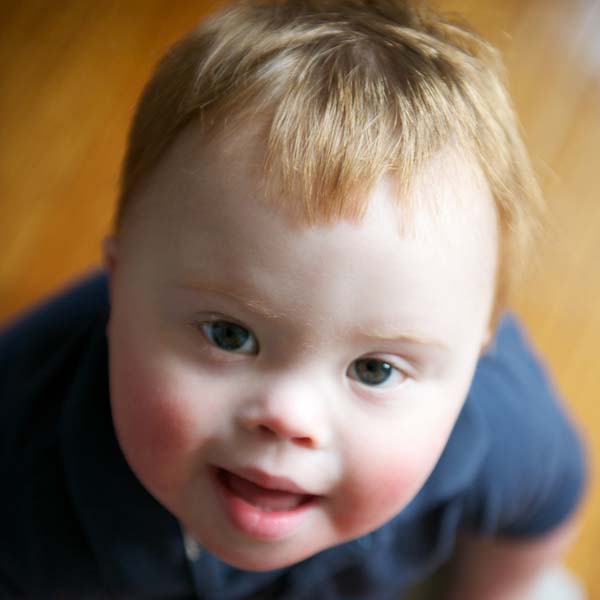
Jake Williams has a knack for making people smile. When I meet with his family in their surburan lounge room, the two-and-a-half-year-old claps and cheers throughout the interview and gently pats his two-month-old brother, Dylan, on the head through our photo shoot.
Apparently that’s par for the course. “When you come home from a hard day at work, the first thing you get is Jakey’s face pushed up against the flywire and he’ll break out into a massive grin,” his father Ollie says. “Whatever’s happened during the day just melts away.”
Ollie and his wife Nikki have endured a rollercoaster of emotions since Jake’s diagnosis at two days old. “I liken it to a grieving process,” says Nikki. “You’re initially shocked, then you go through the anger stage and then acceptance. When Jake was a little baby, we didn’t know what kind of boy he was going to be and whether he’d be able to do all the things that he does now. As time’s gone on, it’s gotten easier.”
The couple believe Jake can reach similar milestones to other children. “We see Jake as Jake; we don’t see Jake as a child with a disability,” Nikki says. “We hope he can live an independent life, but that’s years down the track. There’s no point in planning that. He’s happy in his life right now and we expect that to continue.”
Jake sees a physiotherapist, an occupational therapist and a speech therapist. Nikki also attends a support group for parents of children with Down syndrome. ‘‘You learn things from the other mums as well, so if I’ve got a problem like getting Jake to clean his teeth, I can ask the others if they’ve had similar experiences.”
Adds Ollie: “The whole Down syndrome community is so helpful. They gave us support within a week of bringing Jake home from hospital. It’s been amazing.”
He describes Jake as the heartbeat of the family. “Nikki and I had been living together for quite a long time and he turned us from a couple into a family. I reckon we’ve been gifted to have been given such a little man. He’s a miracle.”
“He has changed our lives for the better,” says Nikki. “He’s taught us to appreciate the positives in life and to take each day as it comes – not set his future path, just let it evolve.”
The Fox family
Like many 14-year-old schoolgirls, Maddy Fox suffered a bout of Beiber fever and is currently experiencing a One Direction infection. She adores dancing, whether it’s tap and jazz with the e.motion21 troop, a dance program for children and young adults with Down syndrome, or at home on the Wii, with sisters Ebony, 16, and Jemima, 10.
When not dancing or at the Concord School, for students with extra needs, she swims with Special Olympics Victoria and, until recently, she also played basketball.
Her parents, Karen and Geoff, support Maddy’s busy social life. They’ve always held an optimistic view of her potential, involving her in numerous mainstream activities. Like the quad bike she was given this year. “Our girls have ridden motorbikes for years and Maddy’s never had one; she’s just jumped on the back and gone for a ride,” Karen says. “We bought her one so she could do the same as the other kids. That exceeded our expectations.”
Maddy is also expected to participate in the family’s daily chores, from making her bed and cleaning her room to emptying the dishwasher. “It helps keep the balance in the family, because we don’t want the other girls thinking she’s getting advantages,” Geoff says.
The family and the wider community encourage other life skills that promote independence, such as reading and counting money. “We’re big on her going to the shops and buying things,” says Karen. “Our local butcher’s fantastic. He lets her order stuff and, if she gets it right, she gets a reward.
“She wants to please everybody and can be very helpful. She tells everybody that she loves them and she honestly does love everybody. We sometimes have to tell her that she doesn’t love everybody quite so much.”
Karen fears that this affection may lead to people taking advantage of Maddy later in life. She also worries that her sisters will one day have to take responsibility for her. ‘‘But in saying this, I worry about all of their futures and where life will lead them,’’ says Karen, before adding that while looking ahead is important, it’s also crucial to live in the moment.
It’s just one of the many life lessons Maddy has inadvertently taught her family. “We learnt acceptance from early on, including who our friends were that would always stand behind us,” Geoff says.
“We know some amazing families we wouldn’t have known had we not had her,” adds Karen. “She’s opened up our eyes and introduced us to another world.’’
The Fisch family
As a member of Melbourne Cricket Club, Andrew Fisch takes great pride in donning a suit and escorting his parents, Christine and Bob, to the footy. The 28-year-old has been a passionate Western Bulldogs supporter since primary school; his love of the Doggies is equalled only by his passion for Greek mythology.
“It’s a mystery to us all,” Christine says of Andrew’s uncanny knowledge, gleaned from Google and his extensive resource library. “I took him to Greece and he just loved it. He could relate to all the stories.”
Andrew, who has worked at a nursery near their home since 2001, has travelled extensively, including to Greece, Rome, Ireland, New Zealand and Taiwan.
His talent for swimming has been the gateway for some of these journeys. Hanging alongside framed Bulldogs memorabilia on his bedroom wall is an impressive number of world championship medals.
“We’re very proud of what he’s achieved with his swimming,” Christine says. “We’re also very proud of his social skills. Andrew is able to go out anywhere with anybody. He can sit around a table and contribute, whether it be politics or refugees. He is noticed for the right reasons.”
Adds Bob: “We haven’t treated him any differently where we possibly could. We decided to give him every possible advantage and I really think it’s gone very smoothly.”
Andrew has a strong sense of family, mentioning his older sister, Emily, when asked how he enjoys spending time. “I like my family,” he says. “Sometimes my dreams come out of nowhere, I know they are pie in the sky, but I think I’d really like to have children. I know that sounds difficult, but I’d really like my Fisch family to continue.”
Bob and Christine smile. “Andrew has a very good insight into having Down syndrome,” says Christine. “He does understand that there are limitations to what he’ll be able to do and that it’s unlikely that he will get married and have a family. He still battles with that and has lots of dreams … So we do have to have reality checks every now and then.”
She admits life has taken a different direction to the one she imagined since having Andrew – “but we have no regrets”.
“It hasn’t been less satisfying,” says Bob. “It doesn’t matter who your son or daughter is, you get a tremendous kick out of every development and every advancement they make in every area.”
WHAT IS DOWN SYNDROME?
What is Down syndrome?
Down syndrome is the world’s most common chromosomal disorder.
In Victoria, between 45 and 65 babies are born each year with the condition.
It occurs at conception with the presence of an extra chromosome. The human body is made up of millions of cells and people with Down syndrome have 47 instead of 46 chromosomes in each cell.
Down syndrome affects all areas of development, but this varies from individual to individual. Early intervention of health and education services shapes the lives of people with the condition more than does the presence of an extra chromosome.
Many people with Down syndrome live past their 60s.
Source: Down Syndrome Victoria.
Details: downsyndromevictoria.org.au