Jo Davy meets an adventurer turned eco-warrior who is making sustainability a hot topic for Australia’s school kids.
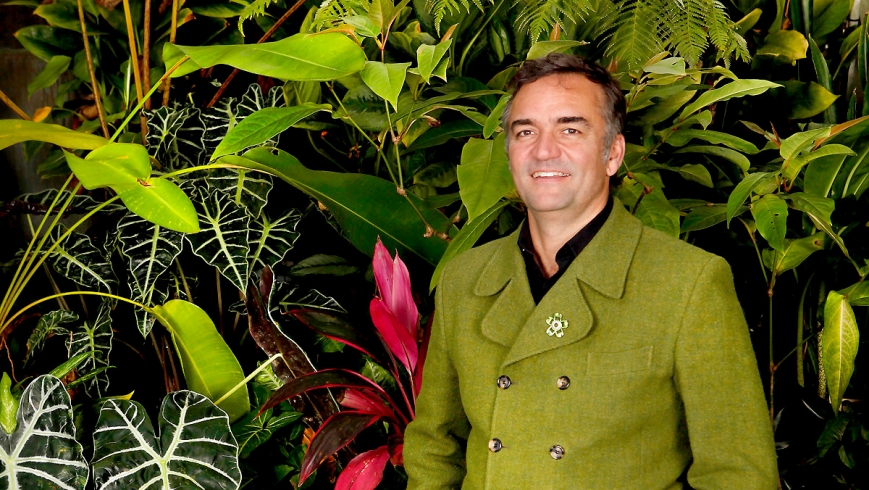
Crouched on a sleek leather chair, eyes alight, his sentences running into one another, eco-warrior Jason Kimberley is like a kid bursting to tell what he learnt at school today. As details of environmental injustices tumble from his mouth between shallow gulps of air, it’s clear Kimberley’s passion for sustainability is unparalleled – even breathing comes second.
There’s some irony in his earnest, almost child-like demeanour. After all, we’ve met at Kimberley’s office in Prahran to discuss his mission to educate school-age children for an environmentally sustainable future.
His organisation, Cool Australia, provides free educational content and activities to students and teachers, from kindergarten to year 10. In 2012, more than 5000 teachers downloaded Cool Australia’s online modules, which reached about 135,000 students.
The numbers quickly caught the attention of the Victorian Association for Environmental Education, which in March named Kimberley its 2012 Sustainability and Environmental Educator of the Year.
Though Kimberley is quick to credit his team for Cool Australia’s success, it’s easy to see why people say yes to this self-described “big kid at heart”.
The son of Just Jeans founder Craig Kimberley, Kimberley didn’t grow up green, spending many an idle childhood afternoon hunting rabbits with his grandfather around the sand dunes at Brighton’s Dendy Beach. “I guess rabbits are an introduced species,” he rationalises.
But he did develop an early interest in the relationships between humans and the land, recalling a childhood preoccupation with stories of doomed Australian explorers Robert O’Hara Burke and William John Wills.
Nowhere was that relationship tested more than on Antarctica, which is where Kimberley found himself on a photographic expedition with mates in 2005.
“I was writing about our adventures and doing some research about Antarctica itself and about the environmental issues: how the Southern Ocean was going, how the penguin colonies and whales and albatrosses were travelling,” he says.
“The situation was a lot worse than I thought … it turns out I really didn’t have much of a clue,” he says.
“And then I thought; ‘Shit, who else doesn’t know about this?’”
It turned out that no one Kimberley quizzed on the subject had much of a clue either, so after publishing his second photography book, Antarctica: A Different Adventure, in 2007, he decided to find out more.
“Whether it’s the albatross getting caught on long-lines, or getting bellies full of plastic, or whales being hunted to the brink of extinction, or fishermen coming down and netting krill by the boatload and taking it back and using it as an additive in pellets for cattle grazing on cleared Amazonian rainforest … it’s all happening because somebody is making a dollar.”
It’s a lot to take in, especially when Kimberley adds, somewhat breathlessly after reeling off such a long list of atrocities, that our environment faces hundreds more challenges exactly like these. That, he argues, is where the importance of education comes in. “If we don’t learn and understand something, how can we possibly come to want to take care of it?”
“My generation, when we left school, we had no idea about any of this stuff. That’s why it’s just so important that current generations and next generations of kids learn about these things, not because they’re green or eco but because our planet is our life support system. Not enough people understand that.”
His decision to target young people, rather than trying to mould more mature minds, was a no-brainer for Kimberley, who says that aside from the adage about old dogs and new tricks, it is a long-term solution for the environment. “As far as I’m concerned, kids are a captive audience. They’re sitting in classrooms all over Australia and they have to be learning something. Why not make some of it about the environment?”
Kimberley enlisted the help of a team of research graduates and curriculum advisers to develop online learning activities and resources for students, based on the core curriculum for each year level.
“The aim was to strip away the complexities, all the dry stuff often associated with sustainability, and get the message across in plain English,” says Kimberley.
This meant integrating information about the environment into all areas of learning, from maths and science to English, and civics and citizenship. Rather than serving as an optional add-on for the lesson plan, the program features elements of the core curriculum, with a tinge of green, of course.
“It has to go well beyond talking only to sustainability teachers or geography teachers,” Kimberley says. “You might have that year 8 maths teacher who says, ‘What the hell has sustainability got to do with me?’ We’ll come back with ‘Well, you can log on, and a dozen learning activities will pop up that are directed at a year 8 maths student. You’ll be learning about biodiversity or energy or climate change in your maths lesson’.”
In 2011, Kimberley launched the project, then known as Cool Melbourne, into 10 pilot primary and secondary schools; a mixture of state, independent, Catholic and special needs schools across Victoria.
The feedback he and his small team received from the Australian Council for Educational Research was overwhelmingly positive, giving them the courage to take their material beyond state borders.
“[ACER] found that teachers were much more confident in teaching sustainability and environmental understanding as a result of using our resources,” Kimberley says.
“The teachers also noticed that the students had demonstrable behavioural changes at home and at school, particularly around waste, water and energy,’’ he says.
“Of course, the holy grail of education is that you want people to understand what they’re doing, and change the way they think about things as a result of that knowledge.”
That’s certainly what happened for Kimberley, who describes his own changed mind-set as an “eco-epiphany” of sorts. For a while there, Kimberley looked destined for a career in the family business. After six months of “not working very hard” at university, he deferred and took a position with Just Jeans, where he remained – apart from a brief dalliance in the restaurant game – until his father sold his interest in the company in 2002.
In the introductory chapter of Antarctica, Kimberley questioned why children are motivated to follow their parents into business. “As the son of the boss, you feel obliged to set a perfect example … in short, conform, which I am not very good at,” he wrote.
Kimberley’s life course changed in 2003 when he decided to self-publish a book of photos taken on a four-wheel driving holiday around Australia with his wife Caroline. He says the decision was the best he ever made. Australia Exposed sold more than 9000 copies in two years, and Kimberley’s images were exhibited throughout Australia, North America and Asia.
“I’d never intended to get into photography, but all these different connections I made; it was just an amazing way of meeting people you would never have met or travelling to places you mightn’t have gone to.”
The Australia Exposed exhibition was the opening event for Los Angeles’ annual G’Day LA celebrations in 2007. This brought a new level of exposure.
“Brooke Shields gave me a kiss,” Kimberley says, excitedly. “Every teenage boy in Australia was in love with Brooke Shields in the ’80s. My dream came true 30 years too late.”
Kimberley began planning an “old-fashioned’’ trek across Antarctica with mates Peter Hillary – Sir Edmund’s son – and Jason Veale in 2004, inspired by some of the continent’s first explorers.
“Most people go to Antarctica and they say they’re going to retrace the steps of someone or climb this mountain,” Kimberley says. “We didn’t know where we were going, or what we were going to find and we had such a blast.”
In hindsight, Kimberley says the trio’s lack of direction helped him better appreciate his surroundings. After 16 days trudging through high winds and temperatures well below freezing, he emerged from the great white continent with the urge to save what was left of it.
Eight years later the Cool Australia website features about 1500 learning activities covering eight environmental topics. The ultimate goal is to achieve the sort of awareness and behaviour change of the federal government’s anti-smoking crusade over the past few decades.
“We wouldn’t even think of smoking inside nowadays,” Kimberley says, thanks to campaigns targeting Australians with health warnings the government introduced on packaging in 1973.
“Kids will go up to a smoker and say, ‘What are you doing? That’s stupid!’ They grow up knowing it’s not good for your health.
“It can’t be an alternative greenie attitude, it needs to be in the mainstream consciousness. A natural reaction.”
Kimberley knows he’s not the only person championing a cause to schools, having faced the challenge of convincing countless principals, teachers and parents to give Cool Australia’s learning activities a chance over competing programs.
Alice Broadbridge, a teacher at Camberwell Girls Grammar, can’t recall how the school first heard about Kimberley in 2009, but she does remember his first visit – an enigmatic environmentalist enthralling her year 7s.
“[Kimberley] is a very energetic person, and he doesn’t talk to a script,” she says.
“He recalls anecdotes and is highly entertaining, but he’s also got a serious message. And I think he manages to blend the two quite successfully.
“At the time, we were trying to make the environmental group at our school more involved, and there were quite a few girls who heard him talk and were inspired to take on some of his initiatives.”
As well as incorporating Cool Australia activities into the curriculum, the school has invited Kimberley back every year since to address year 7s. Broadbridge says it’s an ideal year level to spark the development of good habits.
Kimberley delights in reports from teachers of younger children who say their students see the Cool Australia learning activities more like games than serious learning. But he’s less inclined to talk global warming with his own kids: Florence, 8, Cooper, 6 and Olive, 3.
“I don’t want to shove the environmental stuff down their throats,” he says. “They want to know about what I do, they ask me questions and they’re aware of how we need to respect our natural world, but they’re probably wondering why I spend so much time with other kids and not with them.”
As well as sacrificing time with the family at his Middle Park home, Kimberley has also made significant financial contributions to Cool Australia.
Admitting, rather awkwardly, that the project was initially funded almost entirely from his own bank account, he is full of praise for Cool Australia’s “coolest partner’’, Bendigo Wealth, which came on board as a major financial supporter late last year.
Additional fund-raising comes in the form of charity events held throughout the year, as well as Cool Australia’s Enviroweek at the end of August.
Enviroweek encourages students around Australia to take on a challenge and raise money for their own environmental causes, or donate funds towards Cool Australia’s projects. Since 2009, more than $260,000 has been raised for environmental causes nationwide.
As Victorian Environmental Educator of the Year, Kimberley hopes to expand Cool Australia’s scope in 2013 with the aim of reaching 500,000 students in the next two years. That’s a lot of minds for Kimberley to turn a healthy shade of green, but he’s not fazed.
After all, this is the man who gave conservation a healthy dose of the cool factor.