Fog sits fat and full-bellied on top of the Kinglake Ranges, hiding a sanctuary where animals and humans heal and miracles happen.
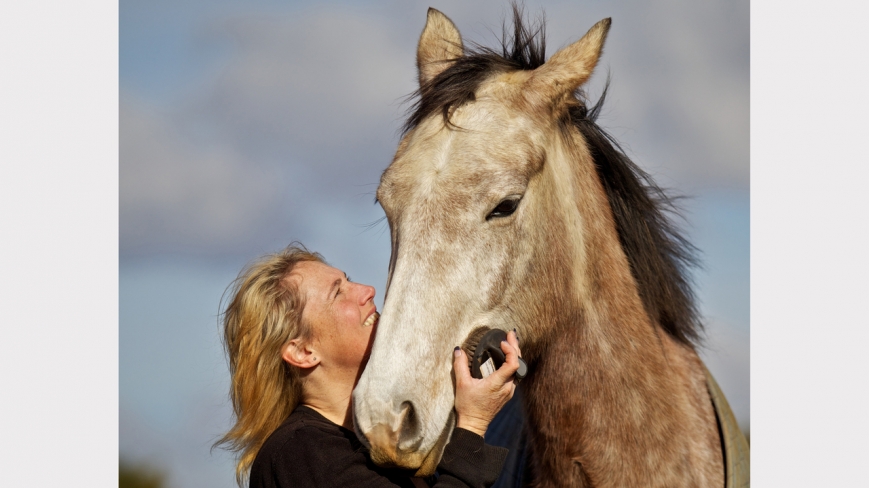
Frost covers the ground in a crisp, white blanket, broken only by the footprints of a woman and a horse walking in quiet partnership in the morning air.
Kirriley Scanlon speaks so low that it is more of a murmur than a whisper, but the thoroughbred twitches its ears and nuzzles her.
The chestnut gelding, Pommy, was a $4 million racehorse owned by a syndicate and raced around the world. But when its competitive days were over, it was abandoned.
“Pommy was just left to die in a paddock and I found a lady, the new owner of the property where Pommy was left, sitting in the gutter crying outside the vet’s,” Scanlon says.
“The horse was skin and bones and had a massive leg wound, and the woman didn’t know anything about horses.”
Scanlon did and stepped in; Pommy, now 15, has a permanent home.
Scanlon was a toddler when she got her first steed, a stock horse called Prince who lived to 40 and passed away five years ago; and she has spent a lifetime caring for rescued horses.
She dreamed of setting up a rescue centre for abused horses, a dream that came true in 1998 when she set up the White Angels Horse Rescue Farm on 20 hectares in Kinglake West with her then husband.
The mother of three mostly rescues horses rejected by the billion-dollar racing industry because they are too slow, sick, old or injured, including those deemed too far gone by other rescue agencies.
When she has money, she attends the reject horse sales and competes with pet food knackeries, buying animals for a few hundred dollars each and rehabilitating them at her farm.
She then re-homes them for free, with the proviso they return to her farm if the foster carers can’t keep them, or she keeps them as “retirees” who graze the lush mountain paddocks on her farm.
“I buy three or four and then spend the next few days crying for the ones I couldn’t save,” she says.
It’s tempting to call Scanlon a horse whisperer, but she is more than that. She is a healer of horses – and people, including herself.
Scanlon has cheated death three times. She survived Black Saturday and, although only 43, suffered a heart attack and stroke in quick succession about 18 months ago.
Her personal trauma started 19 years ago when her mother died in violent circumstances.
“I started helping horses, but really they helped me. I believe that the horses help humans – people with post-traumatic stress syndrome, cancer and a whole lot of problems,” she says.
“A horse’s brain is so much larger than a human’s, and they pick up on so much.
“They have the ability to pick up on people’s needs and are there to nurture people.”
Scanlon has opened her property as Paradise Farm, where emotionally injured people can go and relate to the rescued horses and dogs.
“One woman comes and just wants to be with the animals; to sit in the peaceful space that this property is and be with them,” she says.
“When I walk outside I forget about problems and I want other people to experience that. I call it Paradise Farm because this place is paradise; you walk outside to a beautiful setting and there’s rescue horses and dogs and they give you unconditional love.”
The property bears the scars of Black Saturday, when two fire fronts hit in 2009, luckily leaving most of Scanlon’s sanctuary unscathed. But she is still repairing fences four years later.
“There are still burnt trees and they are a horrible and yet beautiful reminder of who and what we lost. My son lost his best friend and the boy’s entire family and, as a community, we lost so many loved members,” she says.
There was more trauma to come after the fires, including the breakdown of her marriage. Then in December, 2011, Scanlon suffered a heart attack, and a stroke two months later.
Today, she looks happy with her animals, her breath painting the air white in the cold. “Trauma has taught me to cherish every moment I have with my kids, every moment of my life,” she says.
Her life is about saving animals and people, a job she self-finances through her work as a dog masseuse. She spends $7.50 a day for each horse in feed alone, as well as $1200 or more to buy four horses at auction. There are vet bills on top of that, but Scanlon says it’s worth it.
She credits her first horse, Prince, with teaching her the unspoken rules of bonding with animals. “My love affair with horses started with Prince, but as a child dad brought home horses that had never been touched, let alone ridden, and I built a relationship with them,” she says.
“Prince taught me everything I needed to know. He read me, he read other horses. He taught me to be one with the animal. I don’t believe in breaking in a horse. It’s a partnership, a friendship, it’s about letting them know it feels good to be scratched or just to hang out together.
“I never push a horse. I gain their trust and let them give themselves to me, and I to them.”
Sometimes that means gaining the confidence of maltreated animals, including those with worn-down or missing teeth or those that are so malnourished or injured that most rescue groups would put them down.
Scanlon looks for a spark in a horse’s eye – a will to live despite what has happened to them. She pays vet and feed bills and builds them up to be re-homed, while volunteers such as Petra Stampfer give the horses and dogs holistic healing through reiki.
“The reiki is about looking after the animals as you would yourself,” she says.
“Once the horses are rehabilitated, I lease them (for free) so that they can never be sold on, perhaps sold to a knackery if someone’s circumstances change. It means these horses come back to me if they are no longer wanted at their new home, and I can look after them.”
Scanlon usually has about a dozen horses on her property, two elderly resident dogs with cancer and other rescued dogs. She’s also about to take on a few donkeys.
Although she re-homes the horses for free, Scanlon is careful about who gets them. Georgie, a four-year-old thoroughbred mare that stands 17 hands high, is a “ballerina” suitable for dressage rather than standard riding, Scanlon says.
Another horse can only be a companion to other animals because its bad back means it can’t be ridden.
Some horses, including Pommy, are so badly damaged emotionally that Scanlon will never re-home them. She will keep them in the mists of the Kinglake Ranges.
“Enough is enough. They need to be safe,” she says.