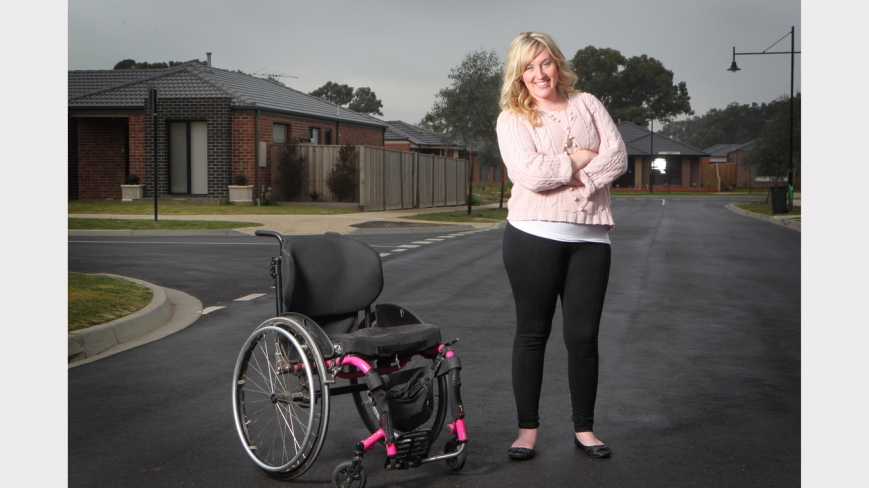
Doctors and physiotherapists told Rhiannon Tracey she would never feed herself again, let alone walk. The 24-year-old became a quadriplegic after a diving accident in Bali in 2009. She was paralysed from the neck down, but was determined not to stay that way.
During her recovery, commuting between the Austin Hospital and the Royal Talbot Rehabilitation Centre, she had “quite a few battles” with staff who told her she would never get back on her feet.
“I had the spinal consultant tell me it was so far out of my books that there was no way I would walk,” she says.
It took Tracey nine months to start taking assisted steps and it was about a year before she started walking. She is now able to walk short distances with a walking frame, has taken up horse riding and enrolled to study business. She lives alone and drives herself in a modified car.
“Recovery doesn’t always mean you can walk again. But I was lucky enough to get there, and worked very hard to achieve it.”
Tracey took part in the hospital-directed rehabilitation but also dedicated her spare time to researching extra physiotherapy, Chinese medicine, acupuncture and massage. “It really is the alternative methods that have got me to where I am today,” she says.
After months of work in Australia, Tracey travelled to the US where she found more comprehensive spinal cord injury services.
Tracey, a Doreen resident, says there are limited services in Australia that offer a comprehensive spinal injury recovery program. She says limited access to health care is even more noticeable in fringe areas such as Melbourne’s northern suburbs.
“There’s nothing really for spinal cord injury,” she says. “You spend more time driving to and from treatment than having the actual treatment.”
It was Tracey’s long recovery that inspired her to open a recovery facility. Tracey’s family, friends and supporters are working towards a one-stop centre, The Next Step: Spinal Cord Injury Recovery. The non-profit centre is backed by fund-raisers, but Tracey says the group needs another $300,000 to $350,000 to secure a facility in Thomastown.
The centre will offer massage, acupuncture, and naturopathy, and focus on intense exercise physiotherapy, “treating the client as an injured athlete rather than someone with a disability”.
There will also be an emphasis on counselling. Tracey says mental recovery is as vital as the physical. “That’s the biggest thing with the next step,” she says. “You can’t focus on the body until you focus on your mind.”
For details or to donate, visit facebook.com/TheNextStepSpinalCordInjuryRecovery or rhiannontracey.com.au.