It has been hailed as a breakthrough for Victoria’s long-suffering taxi passengers – a sweeping industry reform that promises to increase competition, improve customer service and drive down cab fares.
But as new taxi industry tsar Graeme Samuel took to the airwaves last week to spruik the benefits of the government’s just-passed taxi reforms, taxi drivers took to the streets in South Morang, outside the Plenty Road office of Northern Metropolitan MLC Craig Ondarchie, to voice their disgust.
At the heart of the drivers’ angst is a new regime that will open the tightly controlled taxi licence market to new players, allowing any approved applicant to lease a licence for an annual fee of $22,000.
Existing licence holders, some of whom have paid up to $500,000 for the right to run a cab, say the new system has ripped the value out of their prized assets, threatening their financial security and gutting their retirement nest eggs. After all, they say, who would want to pay them half a million dollars for a once coveted licence when they can easily lease one for around 5 per cent of the price.
Also, from July 2014, licence holders leasing their licences to drivers will be able to charge a maximum of $22,000 a year – well short of the $30,000-plus going rate.
While Transport Minister Terry Mulder concedes the changes will decrease the value of the more than 5000 taxi licences in Victoria over time, taxi operator Harry Katsiabanis says the market value of licences has already plummeted by $200,000 since the reforms were mooted last year.
He says many licence owners had mortgaged their home to buy cab licences, believing they were investing in a solid and potentially lucrative long-term asset.
But some banks have already deemed the licences worthless, with a leaked Commonwealth Bank email advising staff that “a nil value is to be extended for Vic Taxi Plates for the foreseeable future”.
Lily D’Ambrosio, the state member for Mill Park, points out that the state government has not offered compensation to people whose cab licences have been savagely devalued.
“Many local families have taken on debt, including mortgaging their homes, to pay up to $500,000 or more for a taxi licence, and some banks have now put a nil value against these licences,” she says.
But while the politicians debate the rights and wrongs of the reforms, three northern suburbs cabbies reveal how they are grappling with the real life consequences.
Ross Maiolo, 45, taxi licence owner from Mill Park
Maiolo’s late father Domenic, who migrated from Calabria, Italy, in the 1950s, was a dedicated cab driver and bought a taxi licence in the 1980s. “When he passed away, he left the licence to mum as a legacy, and my sister and I saw the value of the return [of leasing the licence],” he says.
The siblings borrowed money and bought a licence for themselves in the late 1990s, believing it would provide an inheritance for their children. “We paid $190,000 for the licence at a time you could buy a house for $150,000,” says Maiolo.
Until the taxi reforms, Maiolo, who works as a carpenter, and his sister were getting $35,000 a year by leasing their licence to a driver. “It’s not big money split between two, but we were using it towards our retirement,” he says.
Now the driver, who has leased the licence for a decade, has declined to sign the usual two-year contract and, seeing the portents of change, has negotiated a lower lease fee.
Maiolo says the state government has capped the annual licence lease at $22,000 a year from 2014, and the driver has argued that he will not pay the full rate this year.
“Five or six years ago the licences were valued at $500,000 and I feel sorry for those who bought at the peak. Many of them were new migrants and they were buying them to earn an income; now they have been stripped of it,” he says.
“Banks have put a nil value on licences and people still owe money on them.”
Maiolo’s 74-year-old mother had used the licence lease fee as an income instead of the pension; “now she will have that money slashed and it will impact on her as well”.
“[Professor Allan] Fels [who conducted the Taxi Industry Inquiry] wanted to clean up the taxi industry; you do that by educating drivers; it has nothing to do with the value of cab licences,” he says.
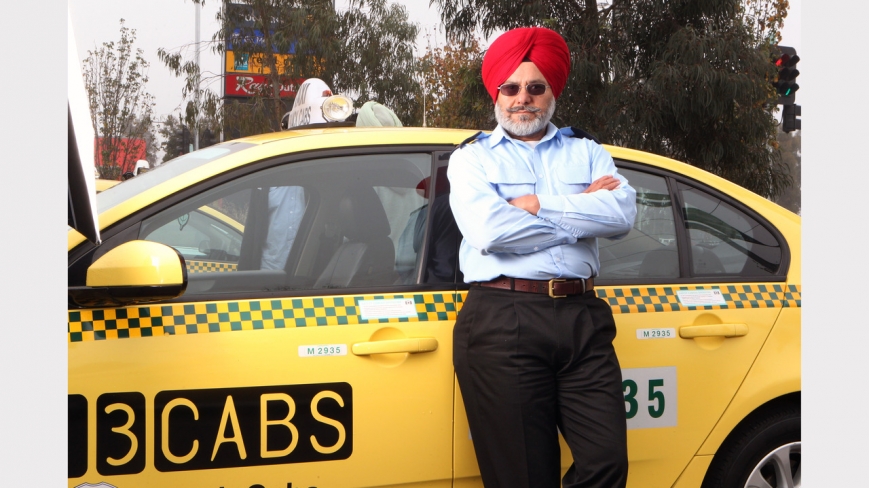
Gursharan Singh Mann, 60, taxi licence owner and driver from Mill Park
Gursharan Singh Mann invested a lifetime in the taxi industry after buying a cab in 1988 for $97,000 soon after migrating from India. “It was big money in those days, you could have bought two houses,” he says, “but I was investing in the future and bought it as a small business. I was looking at it as a way to retire in the future and pay off the [house] mortgage.”
He refinanced the licence three years ago and took out a loan for $260,000. “Back then it [the licence] was valued at $460,000, now some banks are telling us they put nil value on licences,” he says.
“I am 60, I was looking forward to retirement, now no one will buy my licence and I have a mortgage to pay and the loan on the taxi licence, and will be working seven days a week until the day I die.” He says a few years ago a friend paid $520,000 for a taxi licence, unaware of the looming taxi reforms. “These changes will destroy a lot of families, the majority of them migrants; Indians, Somalians, Greeks, Italians, Vietnamese and more,’’ he says.
“I came from India for a better future for my family and I have two children and one grandchild, and the taxi licence was their inheritance. Now all the opportunity, the future for us, is gone. It’s hard for me, there’s so much pressure, I can’t relax and don’t know how I will cope. I live in Mill Park, my house is not a mansion and I am not a millionaire.”
He says although some industry pundits claim licences have dropped from $525,000 to $320,000, “no one is buying at any price”.
“Why would they buy when they can lease a licence for $22,000 a year?”
Mann says taxi licence owners were rocked when a leaked Commonwealth Bank email revealed they were placing a nil value on Victorian taxi plates.
“At my age, there is no future,” he says.
Ahmet Camur, 48, taxi licence owner and driver from Lalor
As a 23-year-old, Camur started driving taxis in his newly adopted home after arriving from Turkey, and decided it would be a lifetime career.
Ten years ago he paid $380,000 for a taxi licence and a further $80,000 for two taxi cabs. “It was big money and I’m still paying off the loan,” he says.
Camur says it costs $250 a day in insurance, car maintenance, loan repayments and other costs to keep his cab on the road.
“If I make $400 a day, I am very, very lucky. If I make $300 a day, I have $50 in my pocket after 12 or 13 hours on the road. And some days I don’t make $300, it is very quiet.”
Camur says recent late-night attacks on taxi drivers have left him rattled and he has decided not to work during peak time on Friday and Saturday nights despite the potential to earn more.
He says he was in Melbourne’s nightclub district late one night and he refused a fare from a group of young men because they were eating, so they jumped on his bonnet. They caused $1600 damage, but his insurance excess is $2000 so he had to pay for it himself.
“It’s too risky for the family to drive those hours; I am a small business operator, not a risk-taker,’’ he says.
“This is my super; as a taxi driver you don’t have super so I invested in a taxi licence for the future for myself and my family, and without [value in] a licence, we can’t live.
“I’ve got a wife and two kids. We used the equity in the house to buy the taxi licence. I can’t sleep at night, I am ashamed.
“My wife warned me not to put all our money into this industry, which is now in big trouble.’’
Camur says he moved to Australia from Turkey for a better life. “About 99 per cent of people in the industry are migrants, we – the Turks, Greeks, Lebanese, Italians, Indians and more – feel we are being victimised.
“It is horrible, a heavy trauma; people are attempting suicide – we can’t see a solution.’’
Camur is very worried about the future and what it means for him and others in his situation.
“I lost a good friend, [and fellow taxi licence owner and driver] Peter, to a heart attack. He was 47 years old; it was all the stress,’’ he says.
“For 25 years I have been a professional taxi driver and have put my life into this industry.”