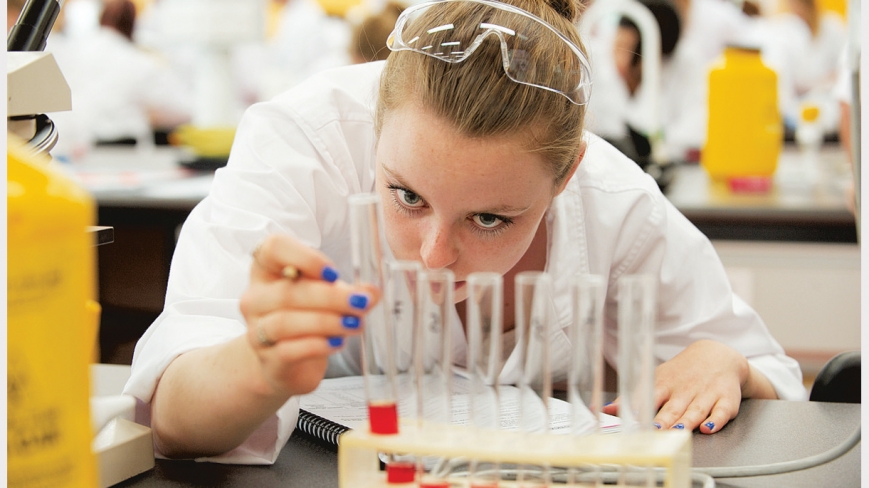
Climate change, disease, over-population – solving the world’s big problems is all in a day’s work for the bright minds at La Trobe’s new science hub, writes Sue Hewitt
At La Trobe University’s new $100 million molecular science centre with its high-tech and expensive equipment, a humble machine is at the core of a research revolution.The common room coffee machine is making more than beverages – it is brewing ideas between scientists and students from various disciplines.
Scientists traditionally stay in their field of expertise, but the man behind the La Trobe Institute for Molecular Science (LIMS) had different ideas.
Professor Nick Hoogenraad, the institute’s director and head of the School of Molecular Sciences, wanted scientists from the fields of biochemistry, chemistry, genetics and pharmacy to mix and share ideas.
“When we built this, we decided to have one common room to share,” he says.
“Now we are all in the same environment and here we can make the greatest contribution to science – collaboration.
“Sitting over a coffee, we are such boring people that we start talking about our research and suddenly someone will say they have this method to bring to a project.’’
Hoogenraad says the machine dispenses 150 free cups of “top quality” coffee a day, and it’s costly. “But because of the coffee, we have scientists talking to people they have never spoken to before and we’re achieving the integration of different disciplines,” he says.
LIMS is also the training hub of future scientists. “We didn’t just want it to be the best research facility and separate the teachers from students,” says Hoogenraad. “We aim to vertically integrate the educational process by placing undergraduate and postgraduate students in the same environment where world-class research is performed.”
The six-storey building with its edgy architecture and 34 laboratories opened in February so that students could learn from cutting edge research.
The institute has an extensive outreach program for secondary school science students, who spend time at the centre with scientists and work on team projects.
One team analysed the contents of an aspirin using a $1 million machine – something a school could never afford, Hoogenraad says.
Biochemistry is the largest discipline. Its 100 staff make up half the academics at the institute. One project involves a “magic bullet” to counter severe weight loss and muscle wastage seen in cancer patients.
“This also happens to us as we age,” Hoogenraad says. “We lose our backside and have muscle wastage, and it could be used for HIV patients or for TB (tuberculosis), which used to be called consumption because the body was consumed by it.”
Brian McGaw, the executive dean of La Trobe’s Faculty of Science, Technology and Engineering, says the world-class research in molecular science, biotechnology and nanotechnology has far-reaching potential to combat disease in humans and plants.
He says research is the only way to deal with new diseases, antibiotic resistance, climate change and a growing population.
The institute has established an international reputation and is driving technological ways to combat disease, he says.
“The LIMS complex, with its capacity for multi-disciplinary research, is crucial to our ability to meet future research challenges, as well as attracting the best students to study with us.
“LIMS aims to train the next generation of scientists in these areas, to translate findings into commercial products, and to develop outreach programs to engage school students.
“This isn’t just important for the research activities here at La Trobe, but also for sustaining the knowledge economy and the prosperity of Victoria and Australia into the future.”
Hoogenraad says scientists who have “proof of principle” that an idea works have to find commercial partners because bringing a drug or another research product to market could cost between $500,000 and $1 billion.
One agriculture and biotech company, Hexima Limited, works out of LIMS. Its board of directors includes La Trobe’s Professor Marilyn Anderson, who is helping to develop varieties of crops resistant to disease and insects for the global food industry.
In the area of human health, Professor Emma Whitelaw says her research focuses on understanding the complex gene interactions that cause diseases such as obesity, diabetes and foetal alcohol syndrome.
Vice-chancellor Professor John Dewar says La Trobe’s research in analytical chemistry, biochemistry, cell biology and microbiology is “well above” world standards according to the Excellence in Research for Australia 2012 report.
“La Trobe is the only institution in the nation to have achieved the ERA’s highest ranking in the field of biochemistry and cell biology in both the 2010 and 2012 rankings,” says Dewar. “LIMS will help us maintain positions of leadership in these fields.”
But Hoogenraad believes it is a humble coffee shared with colleagues that will drive the scientific success of the institute. ■