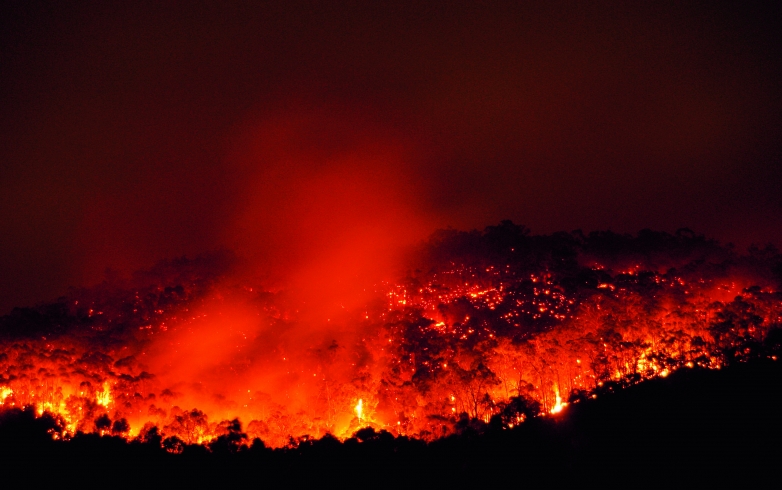
Sue Hewitt reports on new evidence given by four of the 10,000 Black Saturday victims in a class action against power company, SP AusNet.
Carol Matthews and her husband Dave moved from England in 2001 to an 1860s homestead on eight hectares in the peaceful hills of St Andrews to give their children Sam and Ellie a different life in the bush.
Father and son embraced the rural life and joined the CFA for several years, expecting to be alerted to fire danger. But Carol told a Supreme Court hearing into Black Saturday that on the day it mattered the most, authorities did not issue adequate warnings.
Carol and Dave were holidaying in Inverloch, 150 kilometres from St Andrews, on Black Saturday – the day an inferno took their 22-year-old son’s life.
In Kinglake, Jenny and Mick Clark were planning to head to Tathra on the New South Wales coast on Sunday, February 8 – they never made it. On that Sunday, they were in hospital with horrendous burns, and had lost their son, two grandchildren and two neighbours.
In Kinglake West, retired soldier Darrin Gibson, his wife and three children were enjoying family time, while in Upper Plenty, speedboat racer Steve Lackas, his wife Sandra and son Bailey had ponies and chooks to tend to.
On Friday, February 6, the Clark’s daughter Becky Buchanan brought her youngest child, Neeve, 9, to stay with them in Kinglake because Becky was working at the Whittlesea Country Music Festival the next day. On the morning of Black Saturday, Jenny and Mick went shopping in Yarra Glen with Neeve, leaving their son, Danny, asleep.
About noon the same day, Darrin Gibson and his wife Leslie Leahy put their children Kiona, 4, Jye, 3, and Ava, 1, to bed for a nap. The couple also dozed in the sweltering heat. The former soldier has post-traumatic stress disorder and avoided television because it triggered memories of service in Iraq, but he was listening to the radio for signs of danger.
By early afternoon, two CFA men warned Sandra and her husband Steve Lackas of fire danger, but “I didn’t feel a great urgency”, Sandra told the court.
She left with her son Bailey, then 7, and drove to Whittlesea, but Steve insisted on staying to defend their Upper Plenty home of 12 years. About 15 to 20 minutes later, at 2.35pm, she called Steve. “He said there was fire all around and the hay shed had caught on fire,” she told the court. It was the last time they spoke. Despite Sandra’s repeated attempts to ring him, the phone went unanswered.
Steve Lackas was the first of 173 victims to die on Black Saturday. The Bushfire Royal Commission found he died shortly after 3pm inside his burnt out Upper Plenty house.
Around the same time, about 40 kilometres away at the Clark’s Kinglake home, their son-in-law Ross Buchanan arrived with two of his kids, McKenzie, 15, and Aidan, 13, in tow to join their sister Neeve and stay at their grandparents’ “safe” house.
He brought the family treasures, photos, jewellery, papers and his dog, Jazz. According to Jenny Clark’s evidence to court, Ross Buchanan came “because we were told we were a safe house”. Neighbours Penny Chambers, 21, and her sister Melanie, 23, believed so too, and brought their animals along.
By late afternoon Darrin Gibson heard about a fire at Kinglake West on the radio and raced to the top of his driveway. The nearest flames were 200 metres away. At 4.37pm he called the police who said the family couldn’t flee to Whittlesea because the road was closed. Then nearby trees ignited and he told his family to go back inside and lie on the floor. Soon after Darrin grabbed his two youngest and dragged his wife outside. Leslie raced back in to rescue her eldest, Kiona. She later received a posthumous bravery award.
The couple fled the house, seeking safety at the fence line, and then behind some trees.
“Get to the dam!” Darrin told Leslie, but at some point he saw her on the ground cuddling Kiona, saying “I can’t move”.
It was 20 metres to the dam. Darrin’s shoes and feet were melting, he was dropping the two youngest children so he sat Jye on a wet towel and raced Ava to the dam and threw her in. Darrin went back for Jye, but couldn’t find him. He crawled into the puddle of a dam, about 26 centimetres deep, with Ava: “I knew they [his wife and two other children] had passed away.”
In Inverloch, Carol and Dave Matthews did not have access to the internet, but their son Sam was at home in St Andrews monitoring the internet for fire danger . Early in the day he assured them there were no fire alerts.
But Sam rang his mother at 5.22pm and said: “I think it’s time for you and dad to come home now. Things could get bad here.”
Before Carol could ask for clarification, Sam broke in; “Oh, my god, a tree is on fire … it’s just exploded.” His voice changed, he panicked. “There’s fire everywhere,” he said. As her husband “bolted for the door” to return to Sam, Carol heard a loud popping in the background on the phone. All the windows had exploded. Carol told Sam to follow the fire plan and told him she’d ring 000. She couldn’t get through. She rang Sam back about 15 times without success. He had died within moments of their last conversation.
Jenny Clark thinks it may have been 5.30pm or 6pm when fire hit their Kinglake home; she didn’t see it coming. “The front door caught on fire and that was the first we knew,” she told the court. “My dog caught on fire, the smoke alarms were going, [and] the cat screaming.”
Mick Clark and his son, Danny, were “furiously” hosing inside the house without effect and Mick called for Jenny and Aidan to run outside. They did, but couldn’t get to Neeve, McKenzie or the Chambers sisters who were still inside, despite breaking a window and yelling for them to follow. They tried other areas but “the flames were just too big, too ferocious”. Jenny Clark was left with burns to 40 per cent of her body.
As dawn broke the next day, Jenny and Mick Clark had lost their son, Danny; grandchildren, McKenzie and Neeve, and neighbours, the Chambers sisters. Their grandson, Aidan, survived.
When Darrin Gibson and his baby, Ava, were rescued, he had burns to 25 per cent of his body and had to have both burnt feet partially amputated. He was put in an induced coma for a month and awoke to find his daughter had passed away two days after the fires.
Carol Matthews told the court: “One of my biggest fears was that he [her son Sam] was alive but burnt and that he was on the property but couldn’t get out.” She repeatedly asked authorities at road blocks the day after Black Saturday to let her through, telling them “my baby is up there”. When Sam’s body was recovered she asked what “condition” he was in. “You don’t want to know,” she was told. Carol Matthews told Justice Jack Forrest: “We had a good life. On the Friday that was all there. By Saturday everything was gone.”
Lawyers Maurice Blackburn intend to call a further 21 lay witnesses in the case over the East Kilmore fire that killed 119 of the 173 Black Saturday victims.