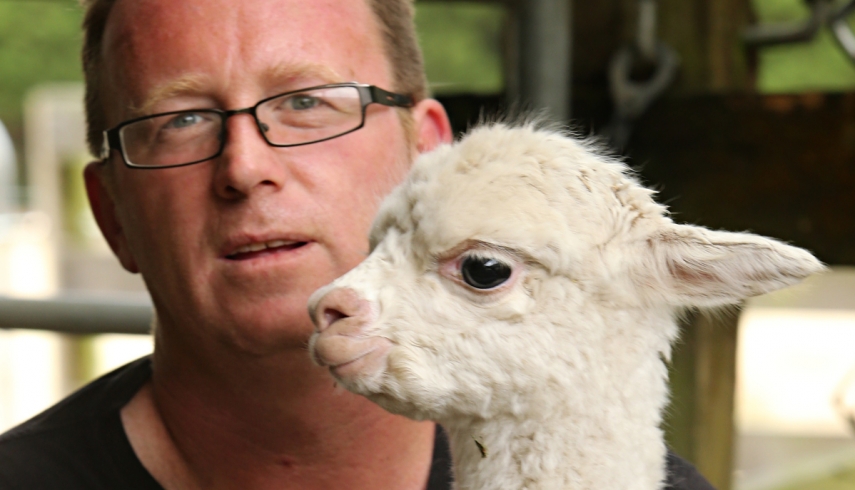
Annaliese is dancing like no one is watching, but her owner Sian Rickards ceratinaly is. Rickards keeps a close eye on all of the 17 alpacas that live on her small farm, Omaru Farm Alpaca Stud, in Cottles Bridge, about a 10-minute drive from Doreen, which will be open to the public next month.
She treats them as her “children”, calling them by name to get a “kiss” and marvelling at their individual characters.
“Annaliese is a little insane,” Rickards says. “She loves to dance – pronking, it’s called for alpacas. They do a little dance with their tails up. It’s comical.
“She’s just a joy to watch.”
About two years ago Rickards, 52, and her husband Rob, 56, decided to replace cows on their hobby farm with alpacas.
“I fell in love,” she says. “We needed something to mow the lawn and that’s when I met my first alpaca, they are beautiful animals.”
Alpacas, from South America, have a sheep’s body on long legs, with a swan-like neck topped by a furry face with large, lashed eyes. Their fleece is prized.
“They are not llamas. Yes, they have similarities, but they are two distinctly different animals and while llamas are larger and used as pack animals, alpacas are used for their fine fleece,” Rickards says.
“Alpacas are so good for the environment. Unlike sheep you don’t have to use chemicals to remove lanolin from their fleece, there is none.
“Their poo is good fertiliser and they leave it in piles.
“They are different from sheep. They are intelligent and they are individuals.”
Rickards puts her hands behind her back and leans forward calling Bandita, a brown female with gentle eyes. The alpaca comes up and nuzzles Rickards, its soft, wet nose pushing into her face.
“That’s an alpaca kiss; delightful,” Rickards says. “Every one of them has their own personality, I know each of the 17 alpacas because they are all individuals.”
Honey Babe is calm and friendly, while Zoe is shy and has black fleece.
The three-year-old studs are Julius Caesar, a stately black-blue male, while one-eyed Silver is a “handsome”, tall grey beast. There’s also the “young boy”, one-year-old Thunderhead.
“Thunderhead was born in a storm,” Rickards says. “His head is black and his body is brown; he’s seriously cute and he’s devoted to Julius Caesar. He follows Julius around like he’s a big brother.”
The males can be walked on halters which is essential when putting them to stud, Rickards says.
A stud is led to a selected female which has been separated from the other animals in an enclosure so that Rickards can improve the genetics of the herd.
“I can choose to enhance the colour or the fleece quality,” she says.
“Alpacas ovulate on demand which means each mating usually results in a pregnancy.”
Once the job is done, the females spit – part of the bad publicity about the species – but only at male alpacas.
“A female alpaca is unlikely to spit at you unless you look like a boy alpaca and she is pregnant,” Rickards says.
“They also sometimes spit at each other when there is food around and you can get caught in the crossfire, but they don’t usually spit at humans.
“Generally you will find interaction with these friendly, gentle, soft, graceful animals will be a joyful experience for both you and the alpaca.”
Rickards also has two castrated males, or wethers, on the farm which act as guard “dogs” for the herd using their front feet to kick predators such as foxes.
“Many Australian sheep farmers are embracing the financial advantage owning a herd guard alpaca gives them. A sheep farmer, running one alpaca per 100 sheep can often expect to save up to 15 per cent of the season’s lambs which would normally have been lost to foxes.”
Rickards says alpacas also make “delightful pets” and can live on small acreage.
A pet alpaca or a guard animal costs about $300 to $400, while stud animals can cost $40,000, Rickards says.
“The alpaca industry is still growing in Australia. There are herds in most Australian states now, with the exception of the hottest northern parts of Australia.”
Rickards is opening her farm to the public for free as part of National Alpaca Week starting May 4 and will have alpacas to feed and pet, fleeces to handle and spinning and felting demonstrations.
“I want to let people get up close and see how nice they are,” she says.
“Most people fall in love with them; they are fascinating and graceful animals. Anyone on one or two acres can keep them.”
■ Omaru Farm Alpaca Stud will be open on May 4–5 and May 11–12 from 11am–3pm.
Details: visit omaru.com.au or nationalalpacaweek.com.au.