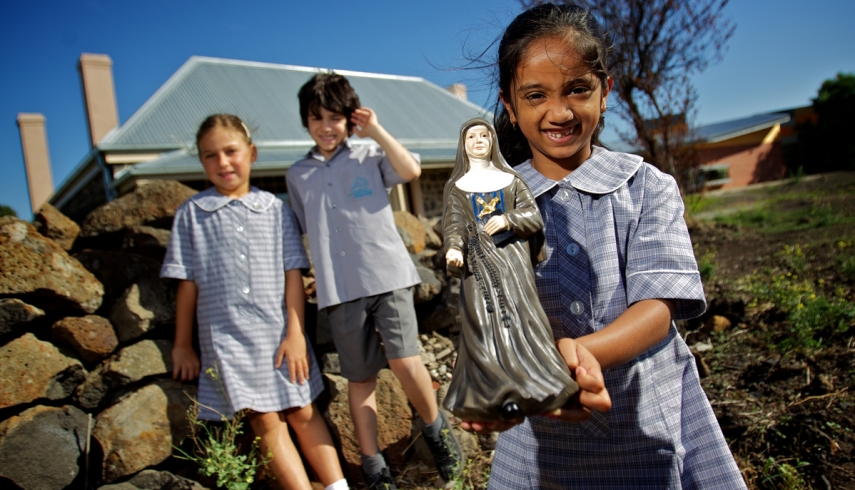
A new school named in honour of Australia’s first saint is a godsend for the northern suburbs.
A saint once walked the dusty roads of Epping North in the 1800s, but few who saw the little girl realised she could perform miracles.
Dressed in the humble clothes of a farmer’s daughter, Mary Helen MacKillop would probably have kicked at loose stones with worn boots or ridden a horse along the tracks that then served as roads.
She was six when her father moved the family from Fitzroy, where Mary was born in 1842, to his wife’s parents’ farm in Epping North.
The first mass in the area was celebrated in 1848 at the home of Mary’s maternal grandparents, the McDonalds.
A priest rode on horseback from St Francis Church in Melbourne to perform the service.
It is not known whether this introduced young Mary MacKillop to her life’s work which, in 2010, led to her becoming Australia’s first and only saint after the Catholic church recognised a series of miracles in her name.
To the people of the northern suburbs she is still performing ‘‘miracles’’ today, in the form of a new school named in her honour: St Mary of the Cross MacKillop Catholic Parish Primary School.
The school’s principal, Geraldine Dalton, says MacKillop’s childhood connection to the area underscores its special relationship with the saint.
MacKillop founded the Sisters of St Joseph of the Sacred Heart, or Josephites, which established schools throughout Australasia for the poor, especially in rural areas.
She opened the first Josephite school in a converted stable in Penola, South Australia, in 1866, and now history has repeated itself at the Epping North school.
Dalton says while her school, built on the historic Creed family dairy farm, has a contemporary building it also has a barn and farmhouse dating back to the 1850s, which have been refurbished.
‘‘The beginnings of our school are very similar to the beginnings of the school Mary set up in Penola on a farm,’’ says Dalton.
‘‘We too are on farmland, and we have a converted barn and farmhouse, and we have strong links to Mary’s early days and her goal of serving the needs of local children.’’ There are 67 students and eight staff at the school but Dalton expects this figure to swell to 500 pupils over the next five years.
It is a godsend to residents of the ever-expanding Aurora housing estate, and is part of the Catholic Education department’s $250 million plan to open 13 schools in Melbourne’s north and west growth corridors, including Doreen, during the next decade.
“We are serving a need for Catholic families; there’s a lot of development in this area with younger families looking for schools,” says Dalton.
“All indications are that building this school was the right thing to do.” The Epping North school cost $4.3 million, with the local community raising $2.3 million and the federal government providing the rest.
The new open-plan building encourages interaction, communication and collaboration, and allows children of different ages to work together and share technology resources, says Dalton.
The school’s eldest pupil is Lisa, who is also the school’s only grade 6 pupil.
Dalton says because the school has personalised education plans, Lisa is not disadvantaged being on her own.
“If there were other grade 6 pupils they would all be on their own individual plans, too,” Dalton says.
As for Lisa, she says she loves the new school.
“I like how when you look outside the windows you see open space and I can’t help wondering what it will look like in the future when my little brother Walter comes to school here [next year].
“I love our colourful school and I love how everything is open [plan].” The official opening on March 3 by McEwen MHR Rob Mitchell and blessing by Denis Hart, the Archbishop of Melbourne, was attended by members of Mary’s Josephite order.
Sister Josephine Dubiel, the Josephite provincial leader of Victoria-Tasmania was accompanied by sisters Shirley O’Toole, Jeanne Dwyer and Mary Davis.
“The children greeted us warmly with lovely smiles and an obvious pride in their new school,” Sister Josephine says.
“With the recently opened restored farmhouse and barn too, we could not help but recall that as Sister Mary, Mary MacKillop opened her first school in a stable, renovated by her brother John, at Penola.
Mary believed that children ‘deserved the best we can offer’.” She says MacKillop’s childhood as the eldest of eight children was not easy.
“In unfortunate financial circumstances, the family had to leave their cottage and move further out from Melbourne and take up farming, first at Merri Creek, and then Darebin Creek [Epping North].
Other members of the MacKillop and McDonald families lived in this area too and Mary would have traversed this countryside visiting aunts and uncles and cousins.” In April 1847, when MacKillop was five, tragedy struck when her maternal grandfather fell into the swollen Darebin creek and died.
“Mary was very fond of her grandfather and even as an adult she would remember him with a tear on his birthday,” Sister Josephine says.
“It was from her grandfather that Mary learnt some Gaelic – he always called her his ‘gnothch miadhail’, meaning ‘my precious thing’.” Sister Josephine believes the family moved to a dairy farm in Plenty in 1853 where Mary’s father, Alexander, stood for the seat of North Bourke in the fairly new Victorian parliament.
“While he had no money to run a big or successful campaign, one of his election policies was to try to get the government to build a school for the 30 to 40 children ‘in this remote part of the colony’,” she says.
“Both Alexander MacKillop and his daughter Mary would be pleased to see such wonderful educational facilities for their neighbours’ children of today.” MacKillop’s presence is everywhere in the new school: from paintings, texts and other symbols of her, to a religious ‘‘relic’’, a revered piece of her 1914 coffin.
Father Maurie Cooney, the parish priest for Epping and Epping North, discovered the relic when he visited the Josephite sisters.
A piece of cedar, measuring about 10 by five centimetres, the relic sits in a glass display cabinet in the school’s administration office, along with a note printed with MacKillop’s words: ‘‘How I wish we would remember that we are but travellers here”.
‘‘Her words …
have an urging about them, and urgency too, and a determination,’’ Father Maurie told the crowd at the recent school opening.
Dalton believes the school will have a lasting legacy.
“Mary’s adult approach is an inspiration for us in this new parish and school venture,” she says.
“By learning about St Mary of the Cross as a person, we can be motivated by her courage, care for others, commitment to action and embracing God in the ordinariness of her life.
Recognising and living these gifts is a wonderful foundation on which to create a new school community.”