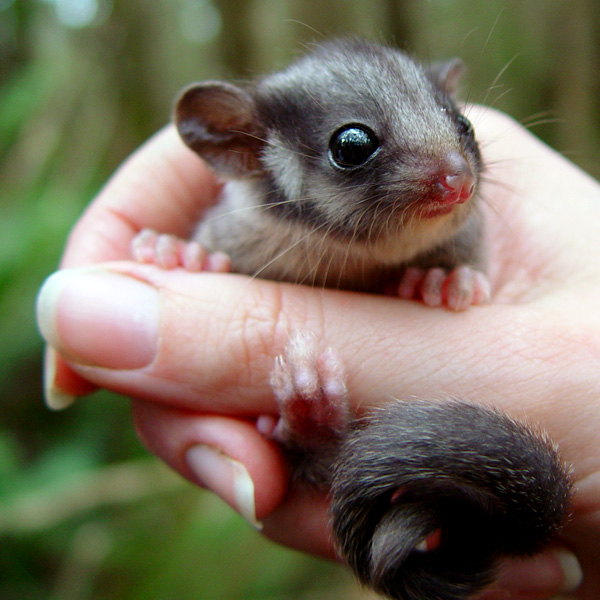
It’s as cute as a button and our state emblem to boot … but the Leadbeater’s Possum is in danger of extinction. Kathryn Kernohan talks to some of the people fighting to save Victoria’s threatened species.
THE Leadbeater’s Possum is tiny. Just 10 centimetres long and weighing less than 100 grams, it can easily nestle in the palm of your hand. And with its long, bushy tail and big, inquisitive eyes, it certainly qualifies as cute and cuddly. It’s a Victorian icon, too – it was anointed the state’s faunal emblem in 1968. But the Leadbeater’s Possum is in critical danger. It is estimated that fewer than 1000 remain in Victoria since their numbers were decimated by the Black Saturday bushfires in 2009.
Put bluntly, without help, the Leadbeater’s Possum will be extinct within a decade. “Nobody else can save it, just us,” says Rachel Lowry, Zoos Victoria’s director of wildlife conservation and science. “It’s absolutely adorable, but when I mention it to people, not many know much about it or that it’s found only in Victoria. They don’t know how badly it was impacted on Black Saturday and how most of its habitat was destroyed.”
In February, Zoos Victoria rangers rescued the last three Leadbeater’s Possums from Lake Mountain and took them to Healesville Sanctuary, where they have become the only examples of the species in captivity anywhere in the world.
Lowry hopes that within three years, Zoos Victoria will have bred enough of them to integrate them back into the wild.
The animal is not alone in its plight. In 2009, Lowry and her colleagues identified 20 Victorian species that were within a few years of becoming extinct.
Also on the list are the Tasmanian devil, the Eastern barred bandicoot, the Mountain pygmy-possum and the Helmeted Honeyeater, among others. They form Zoos Victoria’s Threatened Species Program, one of the organisation’s conservation projects.
“We didn’t want to keep getting phone calls when certain species were down to the last handful. It’s too late then and it’s so demoralising to miss out on saving a species,” says Lowry, recalling how her team narrowly missed out on saving the last Pipistrelle bat on Christmas Island that year. “When you have species literally hanging on and literally in one locality, something like a natural disaster can wipe them out,” she says.
While many Melburnians have fond memories of visiting Melbourne Zoo, and perhaps taking overseas visitors to the world-class Parkville attraction, Lowry stresses that the zoo’s focus has not been on entertainment “for such a long time”.
“Many people have old world views of zoos, where they think it’s just a tourist attraction,” she says. “Not a lot of people in the community realise that we’re a not-for-profit organisation and that all the money we raise – every dollar – is invested back into conservation.”
With Melbourne Zoo’s 150th birthday drawing closer (October 6), Lowry and her colleagues are trying to engage community support not only for the Threatened Species Program but also for other conservation work.
Zoos Victoria’s reach is enormous. More than 1.7 million people visit its three zoos each year, and more than a million visit its website. “How many conservation organisations do you know that have access to that enormous number of people, face to face?” asks Lowry. “We’ve come to realise, in recent years, that if we marry the work we’re already doing with what we call community conservation – conservation driven by community action – we’ll have something really, really powerful.”
Late last year, Zoos Victoria launched its Safe Haven Appeal to raise $85 million over the next five years to modernise what Lowry calls the zoo’s “ageing exhibits” and support its conservation projects.
Zoos Victoria Foundation executive director Pamela Sutton-Legaud says 75 per cent of the zoos’ annual funding comes from donations, sponsorship and corporate partnerships.“Many people think we’re entirely government-funded or that our money comes from other sources, but it doesn’t and we want people to understand that,” she says. “With something like the Threatened Species Program, if we want our native species to survive, we really need people to support their zoo.”
Providing a fun day out for families is a byproduct of the zoos’ conservation work, says Sutton-Legaud. “Most people in Victoria love our zoos, but if they’re of a certain age, chances are they haven’t been out here since they were kids,” she says. “That means they don’t understand how we’ve changed and how our focus is to become a world-leading zoo-based conservation organisation.
‘‘To keep the organisation sustainable, we need people to know everything we raise goes back into the conservation of our species.”
The Safe Haven Appeal has funded a new gorilla exhibit at Werribee and an interactive educational precinct, Growing Wild, at Melbourne Zoo, the first stage of which is expected to be open in time for the 150th celebrations in October.
The Threatened Species Program, which runs at a cost of $2?million, has already had several successes.
A small number of Eastern barred bandicoots, rabbit-sized marsupials thought in the 1990s to be extinct, was found in a rubbish tip in Hamilton. “We stepped in, learnt how to breed them and now we’ve been doing some trial releases,” says Lowry.
Visitors to Werribee Open Range Zoo can see the bandicoots in their natural basalt plains environment. When other species are at a similar stage, they will also be on show.
“These creatures can’t stay back of house any more. They need Victorians to care about them and fall in love with them,” says Lowry. “If every zoo focused on its backyard rather than just the iconic species like lions, tigers and elephants, biology would be in a much better place.”
Zoos Victoria’s threatened species biologist, Dan Harley, who has been involved with the program since it started, says the zoo has “close to half” the 20 threatened species in captivity. He and his team spend months researching a species before “collection day”, when they hope to capture the animals. The creatures are then monitored around the clock before they undergo a breeding program. They are eventually reintroduced into the wild.
“There are different time frames on each species as to when we hope to achieve certain goals,” Harley says. “But the overall goal is the same for each species – to produce each animal to the point where we can put it out there and replenish the wild population.”
Lowry has spearheaded two successful Zoos Victoria campaigns. More than 50,000 old mobile phones have been donated to financially support rangers in the Democratic Republic of Congo, where illegal mining of coltan, used in phones, threatens gorilla habitat.
The fight for mandatory labelling of palm oil in food products continues, even though the Truth in Labelling–Palm Oil Bill was rejected by the House of Representatives’ economics committee last year. More than 160,000 people signed a petition to support the bill, which Lowry believes could help save some of the estimated 50 orang-utans that die each week because their habitats are being cleared for palm oil plantations.
“That campaign (Don’t Palm Us Off) had just a $4000 budget and I was hoping for a couple of thousand signatures. But it completely resonated with the community and within a few months it had inspired Senator Nick Xenophon (who supported the parliamentary push).”
In Melbourne Zoo’s 150th year, Sutton-Legaud hopes people dig into their pockets for the world-class conservation work being done in our backyard.
“The zoo has never really been on the radar of many people as to where they would give their donations,” she says. “But everything helps – from buying something in our stores to adopting an animal or becoming a member of the zoo.
“Hundreds of millions of people enter zoos around the world. If we develop campaigns here in Melbourne and take them globally, we’ll be achieving our aim of being world leaders. Conservation is why we exist – if we’re not doing it, we may as well shut our gates.”
Details: Zoos Victoria.