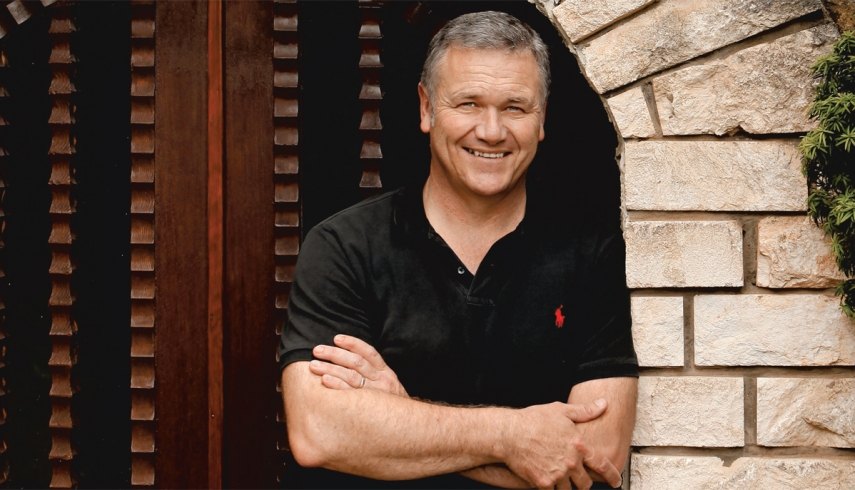
After 25 years in television, Peter Mitchell remains one of the good guys, writes Peter Wilmoth. Photograph by Julian Kingma
They say nice guys come last, but I reckon the opposite is true. Being a nice guy has meant, for Peter Mitchell, a 25-year career being beamed into the homes of millions of viewers, it has meant a long and loving marriage – to Philippa – it has meant five beautiful children and two grandkids, and it has meant the man sitting in front of me here at Channel Seven’s Dockland’s headquarters doesn’t have to prove a thing to anyone. At 52, that’s a satisfying feeling.
I’d never met Mitchell before. The only time I’d seen him away from my TV screen was hosting the Quill Awards for journalism last year. It’s hard to keep journalists quiet – especially when there’s a glass of wine and an opportunity to gossip with a colleague or rival – but that night he did an excellent job of MCing. That night I was sitting next to a talented writing colleague with no paucity of opinions and, thanks to Mitchell’s charm, I think we even shut up for five minutes while he was introducing the next award. That’s some achievement.
Peter Mitchell grew up in Frankston where, for 18 months, his father Geoff was mayor. Young Peter and his brother found it difficult because his parents needed to be out often socialising. “For the 18 months he was mayor we were babysat every night and they’d come home and we’d be asleep,” he says. “It wasn’t great. We knew what was happening. There was a bit of pressure at school. ‘Just because your dad is boss of the world’, that sort of thing.”
He lived in Frankston until he was 12, going to the beach, walking happily down to the shops. It was an idyllic place to grow up, he says. “All my memories of growing up in Frankston are nothing but fantastic,” he says. “Back then it was more of a seaside resort … I went to primary school with a lot of immigrants, British, Italian, Greek, Dutch, all coming into that area. Back then it was pinned as a booming growth area. It wasn’t a sleepy little town any more. It was proclaimed a city in 1966.”
The influx of people from different countries was, for the young Mitchell, an eye-opener. “I tasted olives for the first time; this kid brought a bag of olives (to school). I thought ‘What the hell are these?’
“I used to walk down the street, go to Brashs, buy my first records. The first record I bought was John Farnham’s Comic Conversation. For Christmas I got a little turntable. I put it on, played it to death.”
His parents, he says, “decided to, in their terms, quit the rat race and get a country pub, and they never worked harder in their lives”.
They had the pub, at Katamatite, north of Shepparton, for three years.
Young Mitchell dreamed of becoming a journalist. He wasn’t a fantastic student but had “always done well with words … I enjoyed English and English lit, read a lot of books”.
He wrote to a few places asking for a cadetship and got letters back from Channel Nine and The Herald. It was the late, gruff John Sorell at Channel Nine – or “The Bear”, as he was known – who saw something in Mitchell and hired him. “He said ‘I’ll give you a two-week trial period’,” Mitchell remembers. “I really didn’t know what to do but I went around asking questions to all the reporters and appeared as keen as I possibly could. Two weeks later he said ‘We’ll put you on’.”
Mitchell remembers it as “a completely male-dominated newsroom. There might have been one female reporter …”
On his first day he was mentored by Kate Baillieu, who was reporting for A Current Affair, hosted by Michael Schildberger, whose offices were across the corridor. “Kate Baillieu took me under her wing and went round introducing me to everybody,” he says. “It was absolutely fantastic. I never forgot it. Out of everybody there, she said, ‘You look as if you need some help’.”
Mitchell spent 10 years at Nine – his last gig there was presenting sport on weekends – before receiving a call from Seven when Christopher Skase arrived. Seven had recruited Jennifer Keyte from Ten and asked Mitchell over to do weekend news.
In 1983, when Mitchell was 23, the main sports reporter, Arthur Higgins, was covering the America’s Cup yacht race in Newport, Rhode Island, which created a spot on a Friday night to present sport. “So there I was, Friday night, making my studio debut next to Brian Naylor, who was very encouraging, fantastic, shook my hand. After that it took off.”
Mitchell became Seven’s weeknight presenter in 2000. Years on, he “can’t believe it’s gone so quickly”.
He reflects on the changes he’s witnessed. “It’s a 24-hour news cycle. It wasn’t like that back then. It was sort of like a nine-to-five position, TV news. You packed up after 6.30 and that was it. There was no overnight TV. Now it’s changed so much, and I can’t imagine how much it’s going to change in the next 25.”
Mitchell is also amazed at how quickly his five children are growing up. “The middle daughter is going into year 10 this year and I was only taking her to grade one not that long ago.”
His eldest is 29, married with two children, his son is 27, then there are two daughters aged 15 and 12, and a son aged nine. I say 52 is young to be a grandfather. “It’s interesting,” he says. “You have this tolerance level but the grandchildren just run you ragged. Not as fit, just not as able to cope as I used to be. I was extremely tolerant with my own children, but with these ones you have to understand how energetic they are.”
He was 24 when his first was born. “It was something that our parents did and we just thought it was normal,” he says. “I was considered a young dad and by the time (the youngest) Harry came around I was 43 and that’s considered an old father. So we’d run the gamut of the whole thing.
“I was extremely proud to be a father and the great responsibility involved. We always had in the back of our minds that we’d have a third child. I said to my wife, Philippa, ‘If we’re going to have that third child we’d better get a wriggle on because there’s a big gap’. She said OK, yeah, fine’.
“Had Lucy and she was such a delight we thought we’d go a fourth, we may as well. Maisie was the girl and I said ‘Well, are we going to leave it there?’ and Philippa said ‘That’s enough’. It was a boy, so it was five.
“We’ve had two very distinct groups, the older two and the younger three. Looking back, three together is a nightmare. We should have had two or four because it works out better, the dynamic, how they all sit and get on, travelling in a car.”
It’s become a discussion about parenting and anyone with five children should be listened to. “We haven’t done it by the book,” he says. “There’s no book there.”
What sort of parent is he? “I think I’m a good parent. These days with kids it’s a lot of hands-on work just making sure you’re in control and they’re not sort of running the show, which can easily be done. We’re very strict when it comes to time spent on computers and time away with friends, alone, out on the street, wandering the streets. Our daughter wanted to go to Luna Park with friends, she’s 15 years old. I said, ‘Well, hang on. Is there a parent going?’ We sorted that out, there’s one going now, picking them up. Because you can’t just let them go on their own.
“We’re not helicopter parents, but we do like to be in control. I think we’ve been pretty good and they’ve been fantastic kids.”
I ask Mitchell whether there have been times when he has struggled to maintain his composure on air. “Yeah there have been. Any stories involving children who’ve suffered. I can’t stop thinking about Darcey Freeman (whose father threw her off the West Gate Bridge in 2009). When that happened, it’s just like a jolt … And it wasn’t just that day, it was any time that story came up. But you realise you’re no good to anyone sitting there as a blubbering mess. You’ve got to get on and do the job that you’re paid to do.”
Talk of sad stories leads to the tragic death of veteran newsreader Brian Naylor and his wife, Moiree, in the Black Saturday bushfires in 2009. Naylor was a great mentor to Mitchell. “When I was sitting next to him presenting sport, you just had to see him and the way he operated, he told you everything you needed to know about doing that job.
“I was at Whittlesea on the Sunday after that horrific night of Black Saturday. I was told, ‘We’re doing extensive news coverage and we want you to go to Whittlesea where all the people were coming down from the hill that day’, and there were kids – talk about emotion – there were kids coming down from the mountain, black faces, having lost their house, all their possessions, their school and even some of their friends, in tears, a sort of zombie look.
“And among all that this guy comes over and says ‘Did you hear that Brian and Moiree Naylor were killed’. I said, ‘You know that for sure?’ He said, ‘Yeah, yeah, it’s tragic’. He was in tears. I didn’t know what to do. I said, ‘ I can’t believe it’. I later found out that the CFA were about to shoot an ad the following week at Brian’s property saying if you’re going to stay and fight, this is how you do it. And Brian would have been like that. He would have said, ‘We’ve done all the precautions, here we go’.
“I believe there was a four-wheel-drive parked on the property that wasn’t touched by anything whereas the house went and they were, tragically, inside.”
Mitchell had covered the Ash Wednesday bushfires in 1983. “I was sent down to Warrnambool where seven people had passed away. Forty-one people died in those fires and I thought, ‘We’re never going to see the likes of this again’. And here we are, all these years later, history’s been repeated, and it’s much, much worse.”
I ask Mitchell what makes a great newsreader. “It’s building up that trust with the viewers and Brian (Naylor) had that in spades,” he says. “You knew that when you turned him on every night he’d be there telling you what happened. That’s what Brian did and what I try to do as well. I try to make sure you’re doing the same thing every night, just being reassuring, giving people what they want to know.”
There are unconfirmed reports out of Britain that Michael Palin is the nicest man in the world but I’m putting in a bid for Mitchell to challenge that title. Mitchell is the respectful 17-year-old cadet who turned into the charming, reassuring newsreader, and he’s also the dad in the seven-seater people mover. Twenty-five years into a TV career, being nice hasn’t hurt him a bit.